Two roads at 100
Route 20 and Route 66 Turn 100: America’s Longest Highway and Its Most Famous
US 20 and historic US 66 were both included in the original U.S. Numbered Highway System approved in 1926. A century later, US 20 remains an active current U.S. highway, while Route 66 survives as a historic highway with an unusually powerful cultural afterlife.
Two 1926 designations, not two identical roads. The centennial marks the original route designations. It does not mean that either modern corridor has remained unchanged since 1926.
The shared November 11, 1926 starting point
The U.S. Numbered Highway System received final approval on November 11, 1926, and both US 20 and US 66 were included in that original system. That shared date is a useful starting point, but it is not a claim that the two highways developed the same way.
US 20 grew into its modern Boston-to-Newport extent through later changes. Historic Route 66 also changed over time through multiple alignments. The shared centennial belongs to the numbered designations, not to one frozen road map.
What is actually turning 100
US 20’s designation turns 100 in 2026. Its modern coast-to-coast corridor did not exist in full in 1926: the original western routing stopped at Yellowstone, and later extensions carried the route to Newport.
Historic US 66 also belongs to the 1926 system, but it is no longer an active federal U.S. highway designation. Its legacy is interpreted through historic alignments, preserved businesses, roadside places, and the communities that continue to care for the route story.
Active US 20 and historic Route 66 today
US 20 today
Active and cross-country
US 20 remains a current U.S. highway and a practical planning corridor from Boston to Newport, with the Yellowstone designation break kept visible.
Historic Route 66 today
Historic and interpreted through alignments
Route 66 no longer exists as an active U.S. highway. Its story follows multiple historic alignments rather than one single unchanged route.
What they share
Road stories with local texture
Both roads connect cities, smaller communities, roadside businesses, and travelers looking for a more human-scale view of the country.
America’s longest current highway and its most famous historic highway
US 20 is the longest current route in the U.S. Highway System, a distinction it gained later rather than in 1926. Its identity is expansive: a long sequence of regions, working towns, changing landscapes, and practical route chapters.
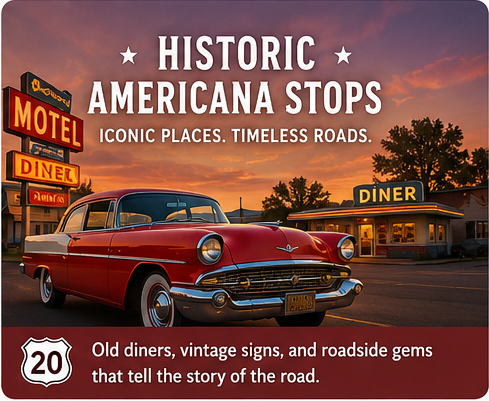
Route 66 is the stronger popular-culture icon. Its heritage-travel identity is concentrated around familiar roadside imagery, preserved businesses, and the pleasure of following historic alignments. That does not make one road better than the other; it gives each road a different kind of invitation.
How the landscapes and trip styles differ
Route 20 works especially well for travelers who enjoy a still-active highway and a broad cross-country structure. The road moves through New England, the Great Lakes, the Midwest, prairie and mountain states, Yellowstone country, and the Pacific Northwest. It rewards a trip built in state-by-state or segment-by-segment chapters.
Historic Route 66 may speak more strongly to travelers seeking a concentrated heritage corridor, famous roadside mythology, and preserved or interpreted historic places. Because Route 66 used multiple alignments, a careful trip should use dedicated Route 66 mapping and local interpretation rather than assume one continuous modern road.
Where the stories meet in Countryside
The roads do have one specific Chicago-area connection. In Countryside, Illinois, modern US 20 on La Grange Road crosses the recognized historic Route 66 alignment on Joliet Road. That physical crossing has its own local guide; it is not evidence that every historic Route 66 alignment crosses US 20 there.
Which road fits which traveler?
Choose Route 20 when you want
An active road in broad chapters
Build a coast-to-coast challenge, compare regional landscapes, follow a live highway, or choose one state and one manageable segment at a time.
Choose historic Route 66 when you want
A heritage-road focus
Seek roadside mythology, historic alignments, preserved businesses, and dedicated Route 66 interpretation and preservation resources.
Choose both when you want
Two ways to read the American road
Use Route 20 for a current cross-country corridor and historic Route 66 for a different, more concentrated heritage-road story.
Explore Route 20 now
This guide is built for practical US 20 planning. Start with the Route 20 overview, use the US Route 20 Centennial for Route 20’s designation and route-evolution history, then choose states, segments, places, or trips for a drive that fits your time.
For broad Route 66 history, itinerary planning, attractions, and centennial discovery, use dedicated Route 66 resources. Route20RoadTrip does not provide a complete Route 66 guide.
Accuracy note
The shared 1926 approval and US 20’s later evolution follow Federal Highway Administration historical material. Historic Route 66 status and changing alignments follow National Park Service Route 66 resources. The Countryside crossing is limited to the documented La Grange Road and Joliet Road relationship.