Three highways · one centennial
The Roads of 1926: US 17, US 20, and US 41 Turn 100
Three American highways. One numbered system. A century of change. US 17, US 20, and US 41 entered the system approved on November 11, 1926, then developed into different modern corridors.
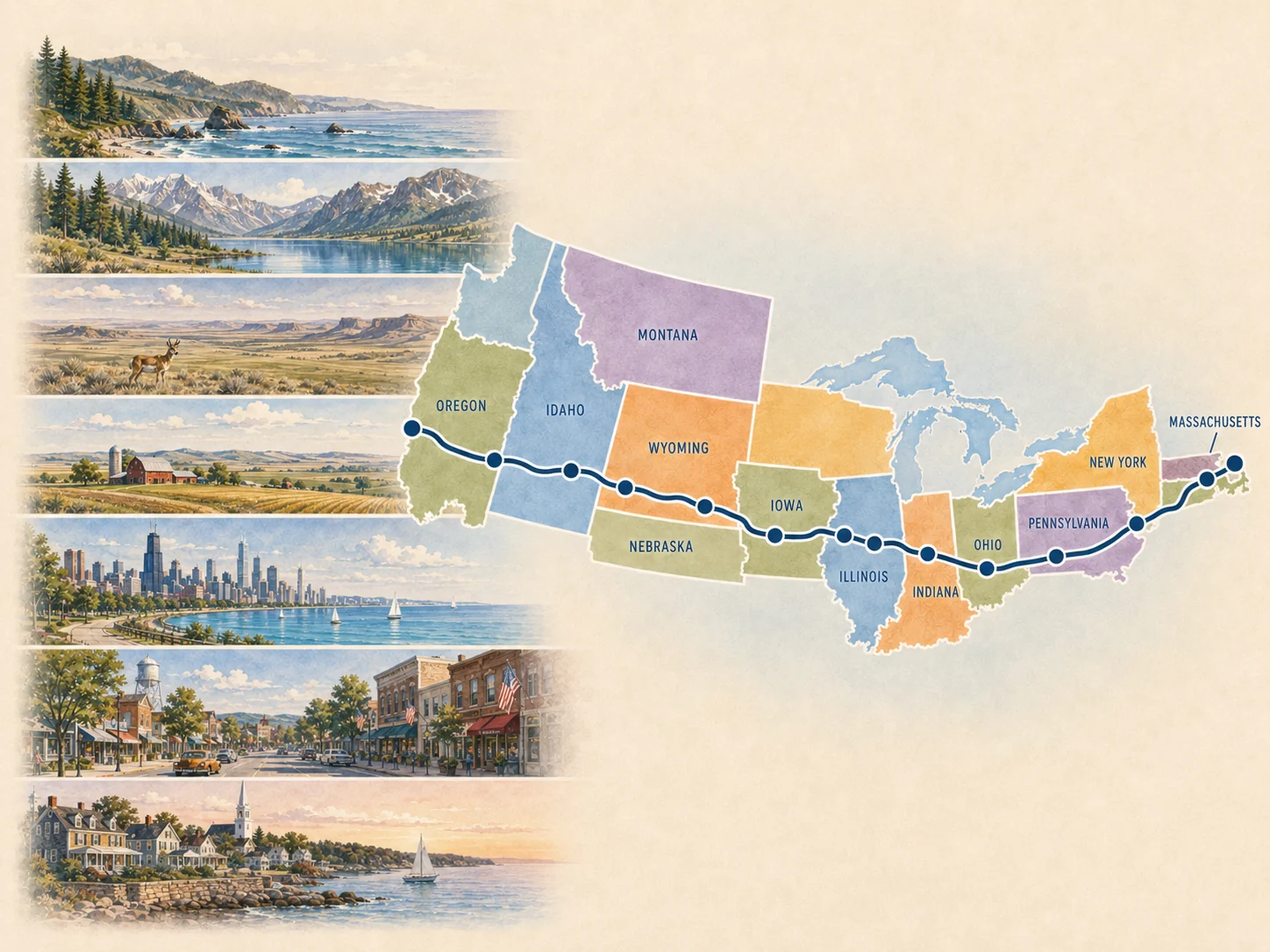
The designation, not every modern road, turns 100. The centennial marks 100 years since the route designations were approved. It does not mean every current mile, endpoint, bridge, bypass, or alignment has carried the same number continuously since 1926.
November 11, 1926: one numbered system
The final approval date gives these three routes a shared historical starting point. It does not make them unchanged twins. Each route has its own original corridor, later chapters, local realignments, and present-day travel role.
That distinction matters most at the edges of the modern routes. A later endpoint or extension can be a meaningful part of a road’s story without becoming a 1926 fact.
Three original designations, three evolving corridors
US 17: Jacksonville to Winchester, then farther south
At map level, original US 17 broadly ran from Jacksonville, Florida, to Winchester, Virginia. The route later extended south through central Florida to Punta Gorda in the early 1930s, creating a later Florida chapter beyond the original southern endpoint.
The exact approval year for that southward extension remains unresolved in the available record, so this overview uses the supported early-1930s timeframe. It does not treat the modern Punta Gorda-to-Winchester route as an unchanged 1926 corridor.
US 20: Yellowstone, Newport, and a later distinction
The final 1926 US 20 routing stopped at Yellowstone National Park rather than continuing to Oregon. Later westward growth changed that reach, and AASHO confirmed the Albany-to-Newport extension in 1943.
US 20 became the longest current U.S. highway after US 6 was shortened in 1963. That is a later distinction, not a claim about the original 1926 system, and the US 20 designation still does not continue through Yellowstone National Park.
US 41: Naples to Copper Harbor, then on to Miami
At map level, original US 41 broadly ran from Naples, Florida, to Copper Harbor, Michigan. Its present Miami-to-Copper-Harbor identity includes a later southern chapter: AASHO approved the extension from Naples to Miami in 1949.
Miami is therefore a later US 41 endpoint, not the original 1926 southern endpoint. The road’s changing Florida history is part of the route-evolution story, not evidence that the modern corridor existed unchanged from the start.
Then and now
US 17
Original corridor, later Florida growth
Jacksonville-to-Winchester is the original broad map-level frame; Punta Gorda belongs to the early-1930s extension story.
US 20
Yellowstone first, Newport later
The 1926 route stopped at Yellowstone. Later westward growth reached Newport, while the longest-current-highway distinction dates from 1963.
US 41
Naples first, Miami later
Naples-to-Copper-Harbor is the original broad map-level frame; the Naples-to-Miami extension was approved in 1949.
What the roads share—and where they diverge
The three designations share the same approved system and the same centennial frame. Their route stories diverge in their endpoints, extensions, discontinuities, alignments, and the ways travelers use them now.
This overview keeps the three centennial stories together while each road retains its own detailed history. Continue to Route17RoadTrip or Route41RoadTrip for those routes, and use Route20RoadTrip for the full US 20 story.
Continue with the route-specific histories
US 17 centennial
Explore US Route 17 at 100
Route17RoadTrip covers the original Jacksonville-to-Winchester corridor and the later Punta Gorda chapter in detail.
US 20 centennial
Explore US Route 20 at 100
Route20RoadTrip explains Yellowstone, the later Newport growth, and the longest-current-highway distinction.
US 41 centennial
Explore US Route 41 at 100
Route41RoadTrip covers the original Naples-to-Copper-Harbor corridor and the later Miami extension in detail.
Related, but separate: Route 20 and Route 66
The Route 20 and Route 66 Turn 100 guide is a separate comparison between two 1926 designations. Route 66 is not part of this three-route overview.
Accuracy and source note
This overview follows Federal Highway Administration material on the numbered system and US 20, the 1926 Bureau of Public Roads system map, and AASHO records for the 1943 US 20 and 1949 US 41 extensions. US 17’s later Florida extension is deliberately described as early 1930s because the exact approval year remains unresolved in the available record.