U.S. Route 20 Road Trip Planner
Use this planner when you know you want a Route 20 road trip, but you still need to choose the right shape. U.S. Route 20 is easier to plan when you start with the job of the trip: a full coast-to-coast crossing, one state, one town-to-town stretch, a weekend, or a set of real stops.

ROUTE TESTED GEAR
Beat the summer heat with gear we approve
These compact microfiber sweat towels earned a place in our road-trip kit after one brutally hot July 4.
See our summer gear pick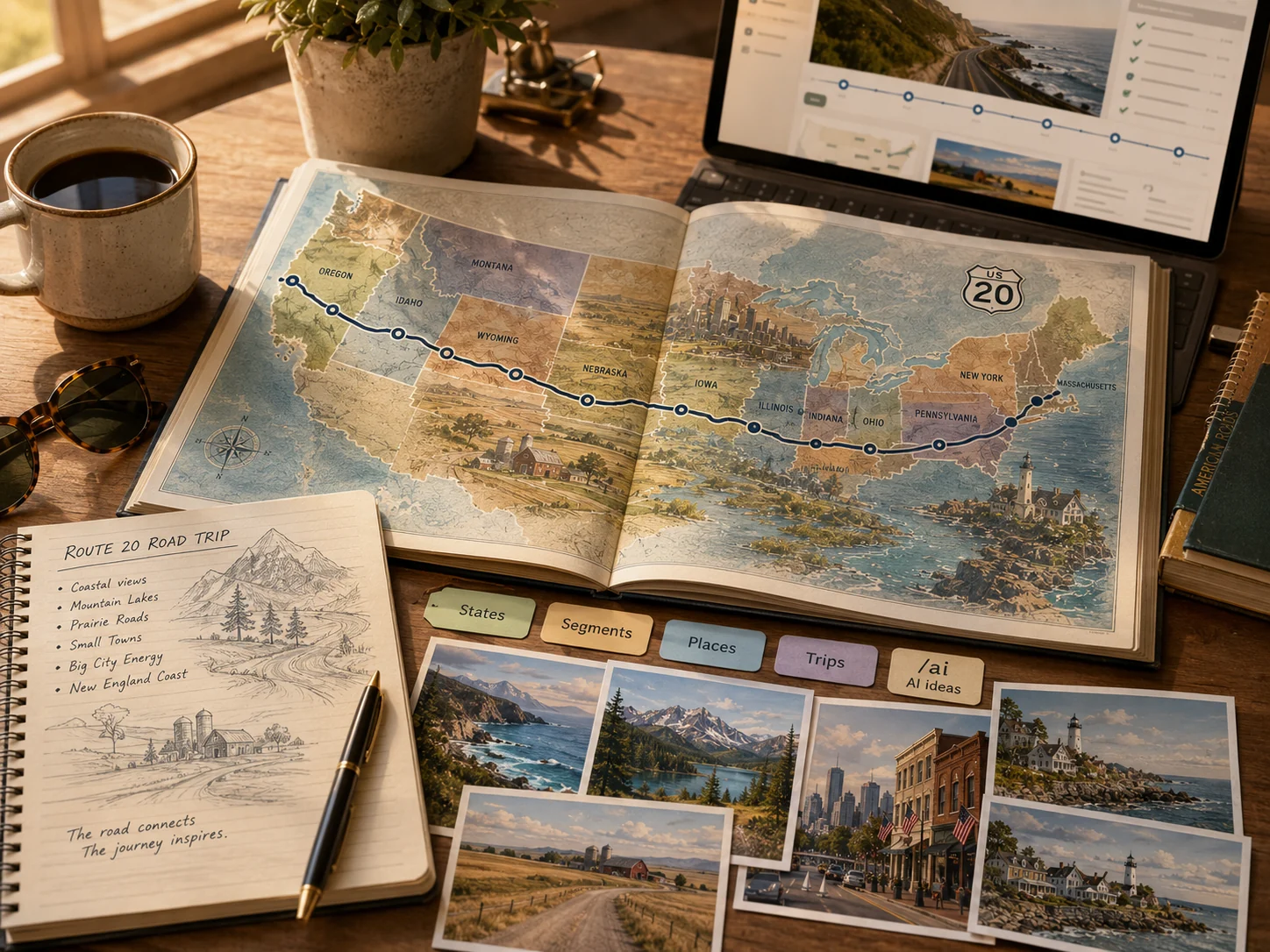
Planning desk · Route 20
Use the planner like a workbench, not a giant checklist
Choose a trip type and planning scale, then use Route 20 AI prompts when you want help narrowing the route into a weekend, a state gateway, a smaller segment, or a place-focused stop.
Try a planner prompt
Planning the centennial: US 20's designation turns 100 in 2026, but not every current mile or endpoint was part of the 1926 route. Start with the US Route 20 Centennial guide for the history, then plan the modern road by state, segment, trip, or stop.
Start here
Get the whole-road view
Use the route overview when you need the Newport-to-Boston corridor, state order, Yellowstone gap context, and key cross-country stops before narrowing the trip.
Choose a frame
Pick a state gateway
Use state pages when the full road is too large and you want a manageable chapter such as Iowa, Nebraska, Ohio, New York, Massachusetts, Idaho, or Oregon.
Build the drive
Break it into segments
Use segments when the planning question is practical: what sits between two towns, where the next overnight should be, or how one stretch connects to the next.
Make it real
Browse actual stops
Use places when the route needs towns, lake edges, main streets, park approaches, food stops, overnight anchors, and reasons to slow down.
Choose your Route 20 trip type
Full crossing
Coast-to-coast Route 20
Start with the route overview, then use states as the main planning chapters. Treat the route as a sequence of bands, not one enormous day-by-day list.
One chapter
State-by-state road trip
Choose one state when you want a clear entry point, a readable map frame, and enough towns to create a real trip without committing to the whole highway.
Shorter drive
Town-to-town segment
Use segments when the trip is built around a driving day, a handoff between two anchors, or a smaller stretch that needs practical pacing.
Weekend first
Manageable Route 20 trip
Use trip pages when you want a first itinerary, a weekend, a scenic connector, or a sampler before planning something larger.
Pick the planning scale
- Use the route overview when you need the full U.S. Route 20 corridor in view.
- Use the Route 20 map when you want one corridor-wide planning view before choosing the next stretch.
- Use states when you want a broad but manageable chapter.
- Use segments when the question is town-to-town pacing.
- Use places when you need real stops, towns, and anchors.
- Use trips when you want a finished first idea instead of a blank map.
- Use the Yellowstone approach and west re-entry pages when your trip reaches Cody, Wapiti, West Yellowstone, Island Park, or Ashton.
- Use Ask Route 20 after you have a rough direction and want help comparing options.
Take the plan on paper
Use the live guide to make current decisions, then move the details you need into a printable that still works when the phone is inconvenient or the trip is already over.
30-page whole-route reference
Route 20 State-by-State Roadbook
Keep the full corridor in one paper reference: twelve state chapters, Yellowstone context, anchor hierarchies, state-line handoffs, and current-source links.
State-by-state keepsake
Route 20 Trip Passport
Mark completed state chapters, record favorite stops, and keep milestone notes as a personal travel record.
Offline-ready notes
Zero-Signal Starter Pack
Write down lodging, route notes, fuel and meal resets, fallback towns, and offline-map checks before leaving reliable service. Rebuild it from current information for each departure.
Post-trip memory workbook
Trip Journal + Legacy Snapshot
Capture what actually happened, what worked, what changed, favorite places, and the next Route 20 chapter worth driving.
Paper is a backup, not a status source: use current road, weather, park, lodging, and local information before travel. The Zero-Signal Starter Pack does not replace live navigation, official alerts, emergency instructions, or local judgment.
Common Route 20 planning mistakes
Mistake
Trying to plan the entire route at once
Start with one planning scale. A whole-road dream becomes easier when it is split into state chapters, anchor towns, and driveable segments.
Mistake
Only chasing the famous stops
Route 20 works best when the smaller main streets, lake towns, prairie handoffs, and western approaches carry some of the trip.
Mistake
Ignoring the Yellowstone context
The western Route 20 story needs a wider view around the park gap and the east and west approaches. Use the overview before locking in a western schedule.
Mistake
Overbuilding the first trip
A good first Route 20 plan can be a weekend, one state, or one strong segment. You do not have to solve the whole highway on the first pass.
Route 20 road trip planner FAQ
For broader route facts and driving questions, use the US Route 20 FAQ.
How many days do you need to drive U.S. Route 20?
A full Route 20 road trip depends on how much time you give the towns, state chapters, and western park approaches. Start with the route overview, then build the trip by state or segment rather than forcing one fixed number of days.
Where should a Route 20 road trip start?
Start where the trip has the clearest purpose. Use Boston and Massachusetts for the eastern story, Newport and Oregon for the Pacific finish or launch, Iowa for a broad Midwest gateway, New York for a strong eastern state chapter, or a shorter trip if you want a first test drive.
Should I drive Route 20 eastbound or westbound?
Either direction can work. Eastbound can make the route feel like a coastward finish toward Boston. Westbound can make the trip feel like a long push toward the Mountain West and the Pacific. Choose the direction that fits your starting point, season, and available time.
Is Route 20 best planned by state or by town?
Use both. States give the trip structure; towns make it worth driving. Start with a state or segment, then use the place pages to decide where to stop, linger, or overnight.
What is the best first Route 20 trip?
For a lower-commitment first pass, start with Route 20 trips. A manageable weekend, one-day sampler, scenic connector, or state gateway is usually easier than trying to plan the entire highway immediately.
Next step: Open the Route 20 overview for the full corridor, or go straight to Route 20 trips if you want a finished first idea.