Build note
US Route 20 at 100: The Long Road Across America
A centennial editorial on US 20's 1926 designation, Yellowstone break, Newport extension, longest-highway status, and coast-to-coast road-trip story.
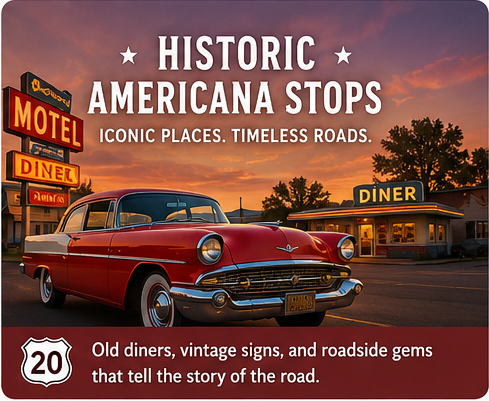
US Route 20 gives America a long way to think about in one number: a road that begins in the Boston area, reaches the Pacific at Newport, Oregon, and still invites travelers to make a cross-country trip one chapter at a time.
What turns 100 is the designation—not every modern mile. The centennial marks US 20's inclusion in the U.S. Numbered Highway System approved on November 11, 1926. It does not mean every current endpoint, bridge, bypass, alignment, or stretch of pavement was part of the route then.
November 11, 1926: one number in a new national system
On November 11, 1926, the U.S. Numbered Highway System received final approval, and US 20 was included in that original system. The designation gave a long east-west corridor a common identity—but it did not freeze the road in place. The route has always been a story of evolution as much as distance.
Boston to Yellowstone: the original frame
The original route broadly ran from Boston to Yellowstone National Park. The final 1926 US 20 routing stopped at Yellowstone rather than continuing to Oregon, so the modern Boston-to-Newport picture should not be read backward into the original plan.
Why US 20 disappears at Yellowstone
Yellowstone is not a footnote to smooth away. U.S. route designations do not continue through Yellowstone National Park, leaving a real designation discontinuity between the route's eastern and western sections. For travelers, that makes the park a meaningful handoff; for the history, it is part of what keeps the road's story honest.
How the road moved west
US 20 expanded west through Idaho and Oregon in the early 1940s. In 1943, AASHO confirmed the Oregon extension from Albany west to Newport. Newport is the modern Pacific endpoint, not the original 1926 western endpoint—and that distinction makes the current coast-to-coast identity more interesting, not less.
Why the longest-highway distinction came later
US 20 became the longest current U.S. highway after US 6 was shortened in 1963. That is a later distinction, not a 1926 claim. Together, the later western growth and the post-1963 status explain why US 20 can be both a centennial designation and a living long-road proposition for present-day travelers.
A living route, not a museum piece
The modern road is best experienced as a connected set of choices: a state, a short segment, a city reset, a small-town overnight, or a full crossing. Its history helps explain the shape of the corridor; the guide helps turn that shape into a trip without pretending every section has the same age or story.
Detailed history
Open the US Route 20 Centennial hub
Use the canonical centennial page for the fuller historical frame: 1926, Yellowstone, westward expansion, Newport, and the longest-current-highway distinction.
Shared 1926 network
Explore the Roads of 1926
See the bounded US 17, US 20, and US 41 overview, then follow each route to its own history.
Trip discovery
Choose from twenty Route 20 experiences
Use the curated discovery layer to find a practical next chapter; it is not the route-history authority.
Bounded comparison
Compare Route 20 and historic Route 66
Use the companion page for its focused comparison, not as a substitute for the main Route 20 centennial narrative.
The road after the anniversary
A centennial date is a useful reason to look up. The lasting invitation is to keep using US 20 as a way to see the country at a human scale: one handoff, one overnight, one chapter of a route whose modern identity was made over time.
Accuracy note: This is an editorial companion. For the detailed historical authority behind the route's centennial story, use the US Route 20 Centennial hub.